The search didn't disappear, it just fell apart. The same question – „which traffic jam removal company should I call in Miskolc?” – is now asked in four places: Google, ChatGPT, Gemini, Perplexity. The latter three don't return a list of results, but a ready-made answer, with two or three company names in it.
It does not follow from this that the SEO is dead. The fashionable claim that „old SEO” consisted of keyword stuffing and link buying is a convenient straw man: whoever did that wasn’t doing well even ten years ago. The real change is more modest and unpleasant.
A technically sound, well-written page still wins today. It's just not enough for Google to find it - it also needs to be machine-readable and citationable for systems that don't necessarily send traffic in return.
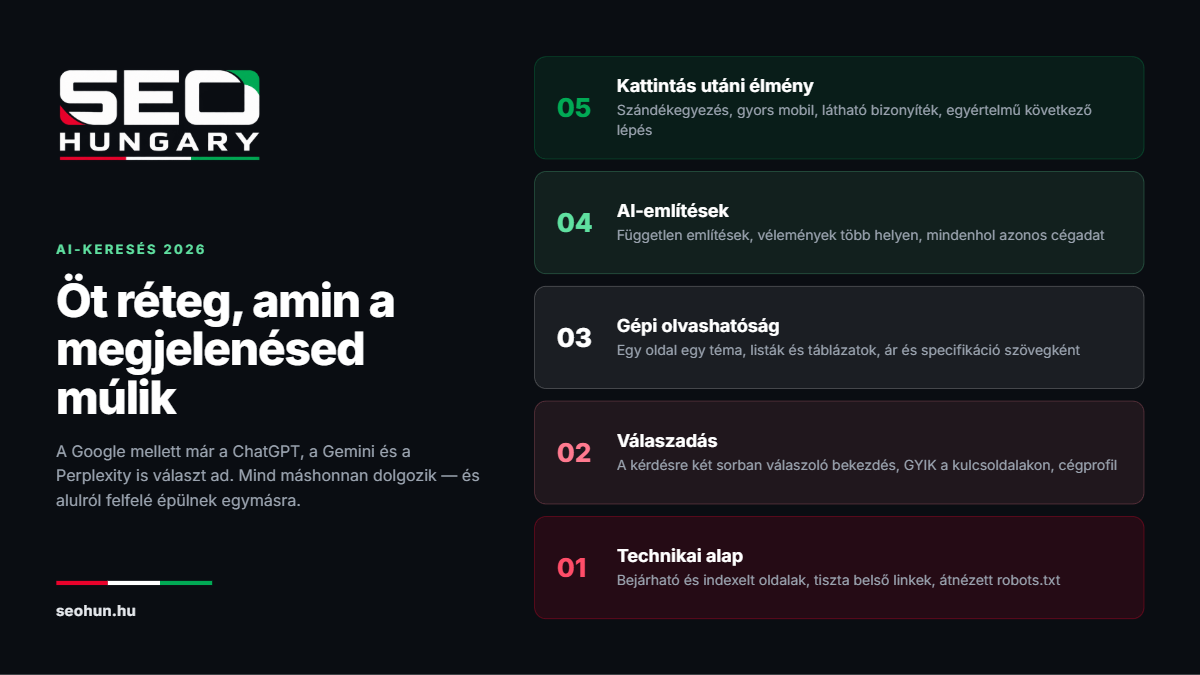
The following five layers provide a framework for this task. None of them are independent professions, and the acronyms attached to them (AEO, GEO, AIO, SXO) promise more than they deliver. However, they can be used as layers: each fixes a different bug, and they build on each other from the bottom up.
1. The technical basis: what is not indexed, no one cites
AI answers don’t come out of nowhere. They typically pull sources from a search engine index and then summarize them. If your page isn’t in the index, it won’t be in the summary – no matter how good the text is.
Therefore, the first step in the AI era is the same as it was ten years ago:
- Walkability. Don't let robots.txt exclude what you want to show. Make sure your sitemap is up-to-date and contains actual URLs.
- Indexability. No accidental noindex on important pages. Search Console indexing report reviewed once a month.
- Internal linking. Don't let it be an orphan page. Anything that has no links to it will be at a disadvantage in both ranking and citations.
- Consistent URLs. A piece of content is available at a single address, sorted by canonical.
One thing is new: in robots.txt you now decide not only about Googlebot. Separate tokens govern the bots that build the source index of AI answers and those that collect data to train models. These two are not the same and can be enabled separately.
| Stick | Operator | What is he doing? | Allow if you want to be quoted |
|---|---|---|---|
| Googlebot | Normal search crawl, which is what AI Overviews and AI Mode work from | Yes – this is the only switch for AI Overviews | |
| OAI-SearchBot | OpenAI | ChatGPT builds its search index and links | Yes |
| Claude-SearchBot | Anthropic | Claude is building its search index | Yes |
| PerplexityBot | Perplexity | Perplexity builds its hits and quotes | Yes |
| GPTBot | OpenAI | Model teaching, not citation | Separate decision |
| ClaudeBot | Anthropic | Model teaching, not citation | Separate decision |
| Google-Extended | Not a crawler, but an opt-out token for Gemini teaching | Separate decision |
The practical conclusion is simple: it is worth allowing search and citation bots, and deciding on teaching bots on a business basis. Many Hungarian sites have robots.txt files with a blacklist inherited from an old template that no one has ever reviewed. This is one of the cheapest mistakes to fix.
2. Answering: answer the question, don't talk about your company
Most Hungarian service provider websites don't start with what the visitor asked. They start with „Our company has many years of experience at its disposal for its customers.” This sentence tells neither a human nor a machine anything.
AI systems – and featured snippets – highlight the paragraph that answers the question in the title in two sentences. Three editing rules solve this:
- The answer should come immediately after the title. Not an introduction, not a story. Bad: „Clogs can occur in any household…” Good: „An average residential drain cleaning service in Miskolc costs 15–35 thousand forints, and is typically resolved within an hour.”
- Number, place, time – instead of an adjective. „Fast”, „reliable”, „favorable price” cannot be quoted. „Within 2 hours, Miskolc and a 30 km radius, from 15,000 HUF” can.
- FAQs on key pages, not on a separate FAQ page. The question should be in H2 or H3, and the answer should be two or three sentences below it. This way, the paragraph makes sense on its own, without context – just like an AI would highlight.
The fourth element is not on the website: the Google Business Profile. For a local service provider, this often matters more than any subpage. Opening hours, service area, phone number and address are written exactly and the same everywhere – on the website, in the company profile and in the catalogs.
The latter is tedious work, and that's exactly why it's neglected. Yet a differently spelled address or an old phone number is enough for the systems to see the same business as two separate companies.
3. Appearance in AI responses: it's not a switch, it's a consequence
This is where most of the illusions need to be dispelled. Promises like „we’ll set ChatGPT to mention your company” are unworkable. There is no setting, field, or paid space that will get you into an AI response.
What really influences which company a model names: how many independent places your name appears in, and how consistently. In order of importance:
- Independent mentions. Professional portals, local news, blogs where your company is mentioned – not necessarily with a link. Just mentioning your name counts too.
- Reviews in several places. Google, Facebook, professional directories. Many places reinforce each other; fifty reviews collected in one place are worth less than fifteen in three places.
- Forums and community content. In the English-speaking world, Reddit is extremely important. In Hungarian, there is no exact equivalent – here, professional Facebook groups, Frequently Asked Questions, and industry forums are the closest parallels.
- Catalogs and company databases. We're not talking about the old link collectors, but about places where company data is listed in a structured way.
The important difference compared to old link building: here it is not the link that gives „power”. It is about the fact that your company’s existence can be confirmed by multiple independent sources. A model names someone because they read the same thing about them from multiple places.
What can you do with this in practice? See where they are mentioned now and where they are not. Organize your company information so that it is the same everywhere. Make it a routine to ask for opinions. And sometimes simply ask ChatGPT or Perplexity – „who would you recommend for this service in this town?” – and see who comes back and which sources they cite. That list is your actual to-do list.
4. Machine readability: the most expensive Hungarian webshop mistake
This layer offers the most immediate repair opportunities, and this is where most Hungarians bleed. webshop.
The point is a measurement: according to the Vercel and MERJ study, the AI crawlers – GPTBot, OAI-SearchBot, ClaudeBot and PerplexityBot – they don't run JavaScript. What the visitor sees, but is only loaded from JS, does not exist for them.
What falls victim to this on an average WooCommerce site:
- Price that is loaded with AJAX. Common with variable products. The robot sees a product page without a price.
- Specification in picture. The manufacturer's data sheet, uploaded as a JPG, contains exactly as much text as a blank page.
- Tabs, accordions, lazy-load content. If the description is only created on click, it is not readable.
- Size chart as picture. Same problem, different clothes.
The fix is not a design issue. The content should be there in the served HTML, and any interactive appearance can remain afterwards. It's easy to check: view the page source without JavaScript and search for the price.
Three additional structural rules that reinforce the same layer:
- One page = one topic. A „our services” page that lists eight services will not have a good answer to any of them. However, eight pages will answer eight separate questions.
- Lists and tables. Instead of a comparison embedded in three paragraphs of running text, a table. This is processed faster by both humans and machines.
- Structured data. Product, LocalBusiness, FAQPage, Service – whichever fits. It's not magic, but it makes it clear what's what on the page.
5. After the click: fewer visitors, more serious intent
Traffic from AI answers is different than traffic from search. It's less, but the visitor is already past the point of information. They got the answer and clicked through to make a decision or purchase.
This changes what the landing page is for. It’s not your job to re-explain the topic – the assistant has already done that for you. It’s your job to immediately provide the four things that are missing from the decision:
- Match. The page should be about what the visitor was looking for. If someone arrives via „traffic jam removal prices”, they should not land on the company presentation.
- Speed on mobile. Not for a Core Web Vitals score, but because the visitor is currently reviewing multiple options in a row.
- Proof on the page. Reviews, reference images, specific numbers. They should not be on another subpage.
- A clear next step. A phone number or a button, in a visible place, even without scrolling.
A measurement note is in order. Some of the traffic from AI assistants shows up in analytics as direct visits without a referrer. So if your direct traffic is increasing but no one has manually typed in your address, it’s worth checking – you may already be getting more referrals than you think.
What to do on Monday morning
It will take you an hour to complete, and at the end you will know which layer you are stopping at. In order, because errors in the lower layers invalidate the work done in their superior.
- Open your robots.txt and see which AI bots are blocked. Use the table above to decide again.
- Search Console, indexing report: is there an important page on the „not indexed” list?
- Turn off JavaScript in your browser and load a product or service page. Do you see the price? Do you see the description?
- Is there a specification or table on your page that only appears as an image? Convert it to text.
- Read the first paragraph of your five most important subpages. Does it answer the question in the title in two sentences?
- Do you have a subpage that tries to cover multiple services at once? Break it up.
- Compare the business name, address, and phone number on the website, Google Business Profile, and two directories. Do they match in letters?
- Ask ChatGPT and Perplexity about your own service in your own locality. Who is coming back and from what source?
- Look at the development of direct traffic in your analytics over the past six months.
- Open your main landing page on mobile. Can you see what you need to do without scrolling?
In summary
You don't need a new profession, but rather to do the existing work on multiple platforms. The technical basis remains the same. We expect more from the text, that it consists of meaningful, quotable units in itself. And the existence of your company must be confirmed from multiple independent places.
Whichever layer on the list above you're stuck on is your next task. And if you're stuck on the first three points, good news: they're the cheapest to fix.
Don't want to go through all five layers by hand?
Our free AI readiness checker looks at the technical foundation, text structure, and mobile experience based on your URL and shows you where you're at.