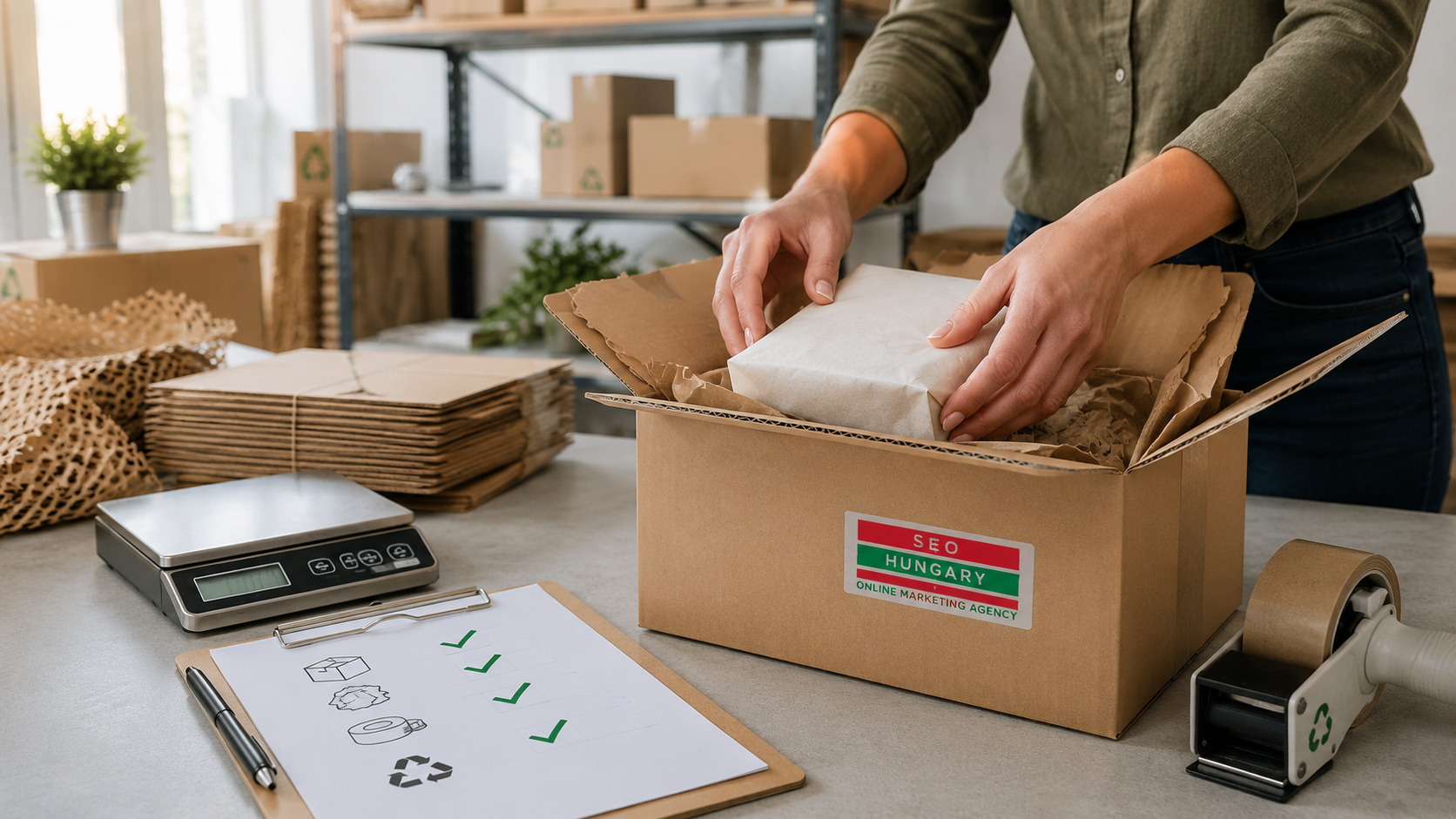
The European Union's new packaging regulation, PPWR, will apply from August 12, 2026, and will also affect Hungarian webshops. However, this does not mean that all online stores will have to immediately replace their shipping boxes, product labels or current packaging materials. The requirements will come into effect in stages, up to 2030 and beyond.
The biggest changes will have to be prepared for by webshops that source products from abroad, sell private label goods, use their own packaging, or sell to consumers in other European Union countries.
Short: 2026 is primarily a year of survey, documentation and clarification of responsibilities. Most of the major packaging technology changes will become mandatory from 2028 and 2030, respectively.
What is PPWR and why did the European Union introduce it?
The PPWR is Packaging and Packaging Waste Regulation abbreviation. In Hungarian it means the EU regulation on packaging and packaging waste.
The official name of the regulation is the European Parliament and the Council Regulation (EU) No 2025/40. The PPWR entered into force on 11 February 2025 and is generally applicable from 12 August 2026.
This is a directly applicable regulation, unlike the previous EU Packaging Directive. While Member States will continue to have their own detailed waste management and EPR rules, the basic technical, sustainability, labelling and compliance requirements for packaging will become increasingly uniform across the European Union.
The main objectives of PPWR are:
- reducing the amount of packaging waste
- reducing oversized and unnecessary packaging
- improving the recyclability of packaging
- increasing the use of recycled plastics
- introduction of more uniform EU waste sorting markings
- restriction of substances hazardous to health and the environment
- strengthening producer responsibility and traceability
What is considered packaging in a webshop?
Many webshop owners think of packaging as just the original box of the product. In reality, it can include almost any packaging material used to fulfill an order.
For example, in the case of an online store, packaging could be:
- the product's bottle, jar, sachet or original box
- the cap, dispenser, dropper and sealing foil
- the product label and its adhesive
- the outer carton
- the courier bags
- the blister
- the air cushion
- the filler paper
- the foam or polystyrene filler
- the adhesive tape
- the shrink wrap
- the strapping
- the pallet
The courier box is also packaged separately.
One webshop You may use your own packaging even if you resell the product in its original condition, without any changes. Any boxes, bags, foil and fillers added when placing the order must be inspected separately.
Example: The original factory box of a laptop and the external shipping box added by the webshop are two separate levels of packaging. In these cases, the same company will not necessarily be the EPR or compliance obligor.
Which Hungarian webshops are most affected by the new regulation?
| Webshop operation | Affection | Most important task |
|---|---|---|
| Buys from a Hungarian supplier and resells unchanged | Lower | Checking supplier documentation and own courier packaging |
| You purchase products from another EU member state | Medium or high | Examination of the first marketing in Hungary and the EPR role |
| Importing from outside the EU | High | Importer compliance, documentation and Hungarian EPR |
| Sells own branded products | Very high | Documenting the compliance of the entire packaging system |
| Packed in its own box or bag | Medium | Record and optimize shipping packaging |
| Also sells to other EU countries | High | Checking EPR obligations by destination country |
| Sell on Amazon, eBay, or other marketplaces | High | Verification of EPR registration and manufacturer data |
Webshops buying from Hungarian suppliers
If the webshop purchases already packaged products from a Hungarian manufacturer or wholesaler, the burden of direct packaging compliance is generally lower. However, this does not automatically mean that all obligations are fulfilled.
The webshop should at least check the following:
- who first brought the product and its packaging to market domestically
- Does the invoice or other document contain the required EPR information?
- Is data on packaging material and weight available?
- Are there any obvious deficiencies in the marking or documentation?
- Who is responsible for the courier box and space-filling material added by the webshop?
Your own shipping packaging must always be inspected separately. The cardboard box, courier bag or foil added to the order by the webshop may be affected even if the product itself came from a Hungarian supplier.
Hungarian webshops purchasing from EU member states
It is a common misconception that there are no further requirements in Hungary for packaging a product purchased from Germany, Poland or another EU member state. However, EPR obligations typically also need to be examined in the country where the packaged product is first placed on the domestic market.
If a Hungarian webshop If a company purchases a packaged product from another member state and then sells it in Hungary, it may be that it will be the first to market the packaging in Hungary.
In this case, you may need:
- to determine the material of product and shipping packaging
- to record the weight of each packaging material
- to determine the appropriate KF codes
- for Hungarian EPR registration
- for data provision
- For payment of EPR fee
The foreign supplier's EPR obligation fulfilled in its own country does not automatically mean that all tasks are in order in Hungary.
What data should we request from the EU supplier?
- the material composition of the entire packaging
- the weight of each packaging element
- separate data on product, collection and transport packaging
- the details of the packaging manufacturer or supplier
- the available declarations of conformity
- information on recyclability
Webshops importing from outside the EU
The liability of webshops importing from outside the EU, such as China, the United States or the United Kingdom, may be significantly greater.
The importer cannot rely solely on the fact that the packaging was selected by the foreign manufacturer. He must check whether the packaging actually placed on the market complies with EU requirements and whether the supporting documents are available.
A generic statement in a supplier's offer stating "EU compliant" or "environmentally friendly" is not sufficient evidence in itself.
What packaging documents should I request?
- the exact material composition of the packaging
- weight of each packaging element
- technical documentation of the packaging
- the necessary declarations of conformity
- verification of compliance with heavy metal restrictions
- PFAS declaration or test results for food contact packaging
- name and contact information of the packaging manufacturer
- production or batch identification
- recyclability information
- detailed specifications of product, collection and transport packaging
Sample order documentation may not be sufficient
The packaging of the sample product may differ from the packaging used in subsequent series production. The cap, inner seal, foil, adhesive, label, or even the cardboard box material may be different.
Therefore, it is advisable to have the actual production packaging approved and documented before placing the final order. The compliance documents should not refer to a previous sample, but to the version that will actually be released.
Private label products: this is where the greatest responsibility can lie
If a webshop markets the product or its packaging under its own name or trademark, the liability of its manufacturer or other economic operators under the PPWR may also arise.
A business may be particularly affected if:
- place your own brand name on the packaging
- you design the product's bottle, box or label yourself
- hire a contract manufacturer to produce your own branded product
- uses its own outer carton or decorative packaging
- You import a private label product from a manufacturer outside the EU
The entire packaging system must be examined
For example, for a 100 ml private label oil, the glass bottle is not the only thing that matters. Separate packaging elements can be:
- the glass
- the cap
- inner seal of the cap
- the dispenser or dropper
- the label
- the label adhesive
- the outer carton
- the collective packaging
- cardboard box and packing material used for shipping
It is advisable to record their material, mass, supplier and compliance documentation in a unified system.
Food contact packaging and PFAS restriction
From August 12, 2026, food contact packaging cannot be placed on the market if its PFAS content reaches or exceeds the limits set out in the PPWR.
For packaging of foods, oils, beverages and some dietary supplements, it is therefore necessary to check not only the glass or bottle, but also the cap, seal, coating, dispenser and other parts that come into direct contact with the food.
It is important to note that the PPWR does not replace other legislation on food labelling, food safety or food contact materials. These requirements apply alongside each other.
PPWR and EPR: not the same two obligations
The PPWR and the Hungarian EPR system are closely related, but they do not regulate the same thing.
What does the PPWR regulate?
The PPWR defines, among other things:
- What kind of packaging can be placed on the market in the European Union?
- what materials and under what conditions can they be used
- how to minimize packaging weight and volume
- When is packaging considered recyclable?
- what documentation and traceability is required
- what labeling system will be introduced
- what reuse and recycled material targets apply
What does Hungarian EPR mean?
EPR is the English Extended Producer Responsibility, which is the abbreviation for extended producer responsibility. In Hungary, the detailed rules of the system are currently primarily determined by Government Decree 80/2023. (III. 14.).
The affected businesses may experience:
- registration with the national waste management authority
- MOHU registration
- Keeping records according to the KF code
- recording the weight of packaging placed on the market
- quarterly data reporting
- Payment of EPR fee
- applying the necessary invoice texts
Under Hungarian regulations, the general data reporting deadline is the 20th day of the month following the quarter in question. Different rules may apply to certain special or simplified cases.
A package may be technically PPWR-compliant without the company properly complying with the Hungarian EPR administration. Payment of the EPR fee alone does not prove that the package meets the technical requirements of the PPWR.
Hungarian webshops selling abroad
If a Hungarian webshop sells directly to consumers living in another EU member state, the packaging typically becomes waste in the destination country. For this reason, in addition to the Hungarian registration, an EPR obligation may arise in another member state.
Depending on the country, it may arise:
- local EPR registration
- local data provision
- Payment of EPR fee
- appointment of an authorized representative
- applying local packaging or return marking
Hungarian EPR registration is therefore not necessarily sufficient for the webshop to comply with packaging obligations in all countries of the European Union.
What can online marketplaces check?
Amazon, eBay, and other online marketplaces may also ask for:
- the EPR registration number
- the manufacturer or importer's details
- the packaging category designation
- the details of the authorized representative in the country of destination
- verification of the conformity of the packaging
Missing or incorrect EPR data may also lead to product listings being restricted or suspended in some cases.
Reducing oversized webshop boxes
One of the most visible changes will be the limitation of empty space in e-commerce packaging.
Under the PPWR, economic operators filling group, transport and e-commerce packaging must ensure that the proportion of empty space is no more than 50 percent be.
The requirement shall apply from 1 January 2030 or three years after the entry into force of the implementing rule setting out the Union calculation method, whichever is later.
Space-filling material also counts towards empty space
When calculating void space, the area occupied by space-filling material can also be considered void space. Such material can include:
- crumpled or cut paper
- the air cushion
- the blister
- the foam sponge
- the wood chips
- polystyrene filler
- other similar filler
Important: A box that is too large will not be made suitable if the webshop adds more filler paper or bubble wrap.
Simple calculation example
- Internal volume of the box: 20 liters
- volume of packaged products: 8 liters
- empty space: 12 liters
- Empty space ratio: 60 percent
In this simplified example, the packaging would exceed the 50 percent limit. However, the official EU calculation method will be used to determine final compliance.
What does this mean in the daily operations of webshops?
Online stores are expected to:
- they need to keep several box sizes in stock
- they need to be more precise in selecting the packaging that fits the product
- It will be worth recording the dimensions of the products and boxes
- they need to transform some warehouse and packaging processes
- should prefer height-adjustable boxes
- they should reduce the amount of unnecessary filler materials
Adequate product protection remains a fundamental consideration. The rule is not intended to ensure that fragile goods are transported unprotected, but rather to use the smallest packaging actually necessary for protection.
When is change expected?
| Date | Change | Impact on webshops |
|---|---|---|
| February 11, 2025. | Entry into force of the PPWR | The preparation period has begun |
| August 12, 2026. | Start of general application of the Regulation | Roles, documentation and suppliers need to be reviewed |
| August 12, 2026. | PFAS limits for food contact packaging | Food and private label webshops must check contact materials |
| Expected from 2028 or later | More uniform EU packaging and waste sorting labels | Labels and packaging graphics may need to be modified |
| From 2029 | 90 percent separate collection target for certain single-use beverage packaging | Beverage packaging and return systems are primarily affected. |
| From 2030 | Recyclability requirements | Some packaging materials or packaging designs need to be replaced |
| From 2030 | Mandatory recycled content for certain plastic packaging | Supplier certificates and new raw materials may be required |
| From 2030 or later | Up to 50 percent void ratio | Courier boxes and packaging processes need to be redesigned |
| From 2030 | Restrictions on certain single-use plastic packaging | In some areas, a shift to alternative packaging is required |
Certain deadlines also depend on the publication of related implementing and delegated EU legislation. For this reason, webshops should regularly monitor the development of detailed rules.
Do product labels need to be redesigned now?
The new, uniform EU waste sorting pictograms will not be mandatory on all packaging in August 2026. The exact graphic, colour and design requirements will be determined by further implementing rules.
According to the PPWR, the deadline for general packaging composition labelling is 42 months from the entry into force of the Regulation or 24 months from the entry into force of the related implementing act, whichever is later.
If a business is now designing a new label, it is worth:
- leave space for a later pictogram
- consider placing a QR code or other digital media
- preserve the original, editable graphic files
- avoid unofficial or ambiguous environmental labels
- choose a layout that can be easily modified later
The QR code itself does not automatically trigger all mandatory physical markings. And the PPWR does not allow for the omission of information that is required by other product safety, consumer protection or food law regulations.
What should a Hungarian webshop do now?
The most important task at present is not to immediately replace all packaging materials, but to accurately map the existing system.
12-point webshop checklist
- Make a list of all packaging materials used.
- Separate product, collection and transport packaging.
- Weigh the weight of each packaging item.
- Record the material type, supplier, and country of purchase.
- Separate Hungarian, EU and non-EU purchases.
- Determine who is the first to market each packaging in Hungary.
- Check waste management authority and MOHU registrations.
- Review the KF codes and EPR data reporting.
- Request packaging documents from suppliers.
- For food contact packaging, request a PFAS declaration or test results.
- Assess the empty space ratio of current courier boxes.
- When selling abroad, check EPR obligations by country.
The most common misconceptions
„All boxes must be replaced on August 12, 2026”
Not true. The PPWR will be generally applicable from this date, but a significant portion of the labelling, recyclability, recycled content and void space requirements will come into effect later.
„"If I buy the box from a Hungarian company, I have no responsibilities with it"”
This is not true in all cases. It is necessary to investigate who qualifies as the first domestic marketer of the given packaging and what additional packaging materials the webshop provides with the order.
„By paying the EPR fee, we have complied with all packaging regulations”
Not true. EPR is primarily a waste management, recordkeeping and financial obligation. PPWR also imposes technical, material use, design, documentation and labelling requirements.
„The bubble wrap fills the box, so it doesn’t count as empty space”
Not true. The area occupied by the space-filling material can also be counted as empty space.
„With a Hungarian EPR registration, we can sell throughout the EU”
Not necessarily true. When selling to end users in another Member State, separate obligations may arise depending on the destination country.
„Micro-enterprises are exempt from all rules”
Not true. The PPWR provides relief or narrow exceptions for micro-enterprises in certain cases, but there is no general exemption from all packaging and EPR obligations.
What costs can webshops expect?
The costs of preparation depend on the size of the webshop, the method of procurement, and the complexity of the packaging.
For example, you may encounter:
- packaging material testing cost
- the cost of obtaining supplier documentation
- creating new labels and packaging graphics
- purchasing and storing various types of courier boxes
- transformation of warehouse processes
- introduction of a packaging registration system
- EPR consulting and administration
- foreign EPR registration
- authorized representative fee
- management of marketplace compliance data
However, the change can mean more than just additional costs. More precisely sized packaging can reduce the amount of material used, the need for storage and, in some cases, shipping costs. More conscious packaging can also improve the customer experience and brand perception.
Frequently Asked Questions about PPWR
When does PPWR apply to Hungarian webshops?
The regulation entered into force on 11 February 2025 and will generally apply from 12 August 2026. Some detailed obligations will apply from 2028, 2029, 2030 or later.
Is it mandatory to replace courier boxes in 2026?
Not automatically. However, the webshop should already assess the boxes used, the packaging materials, and the empty space ratios.
Does the space filler paper count towards the empty space?
Yes, according to the PPWR, the area occupied by the space-filling material can also be considered as empty space. The exact calculation method will be determined by an EU implementing rule.
Who pays the EPR fee for a product imported from abroad?
The obligation should be determined based on the specific procurement and sales process. If the Hungarian webshop first places the packaged product on the domestic market, it is typically the one that may be subject to the Hungarian EPR obligation.
Who is responsible for the packaging of a private label product?
For packaging marketed under its own name or trademark, the brand owner may have significant compliance responsibilities. The exact role will depend on the manufacturing, purchasing and packaging design.
Is a separate EPR registration required when selling to another EU country?
Yes, separate registration, fee payment and appointment of an authorized representative may be required for each destination country. Hungarian registration is not necessarily valid throughout the European Union.
Will it be mandatory to put a QR code on all packaging?
It is not possible to state in general that all packaging will require a QR code. In certain cases of reuse and digital information, digital media may be required, but the detailed requirements may vary by packaging type.
Are micro-enterprises exempt from PPWR?
There is no general exemption for micro-entrepreneurs. There are reliefs and exceptions for certain obligations, but these should always be examined based on the situation of the particular enterprise and packaging.
Summary: 2026 is the year of assessment and preparation
The new EU packaging rules may affect almost all Hungarian webshops, but not to the same extent. The greatest compliance risk occurs for webshops that import from outside the EU, distribute private label products and also sell to consumers in other member states.
The most important task in 2026 will be to assess procurement routes, packaging processes and EPR status. Webshops should now organize packaging data, request supplier documents and examine how effectively they use courier boxes.
This way, you can prepare for future changes in labeling and packaging technology gradually, with predictable costs.
The most important message: A webshop does not necessarily have to replace all its packaging in 2026, but it does have to map and document all its packaging.
It is also worth preparing your webshop for the changes
Packaging regulations can also impact the operation and communication of your online store over time. Product data, supplier records, warehouse processes, marketplace data, and some customer information may need to be changed.
If you are starting a new online store or want to upgrade your existing system, read on. Our WordPress and WooCommerce web store creation service. And if you want your webshop to get more relevant visitors and customers, check out our search engine optimization service also.
Contact us and let's discuss the development and online marketing options for your webshop!
Official sources used
- Regulation (EU) 2025/40 of the European Parliament and of the Council
- European Commission PPWR information page
- European Commission summary of new packaging rules
- European Commission 2026 PPWR Guidance
- Government Decree No. 80/2023 (III. 14.) on the extended producer responsibility system
Legal notice: This article provides general information and does not constitute specific legal, tax or waste management advice. The obligations for each business must be determined based on the specific purchasing, packaging and sales process.